There is a rule in Google Merchant Center that reads like a contradiction the first time you meet it. Import duties may not go in your price attribute. They may not go in your shipping attribute either. And yet Google still expects the shopper to know about them before they buy.
Both halves are true, and the way you resolve them is a disclosure on your own site. Most Shopify merchants never do it, because nothing breaks until it does — and when it breaks, it tends to break as a misrepresentation review rather than a tidy little feed warning.
This got sharply more relevant in 2025. The US suspended duty-free de minimis treatment for shipments from China and Hong Kong on 2 May 2025, and for essentially all other countries on 29 August 2025. Before that, most sub-$800 parcels landed on a US doorstep with no duty attached, so cross-border stores could ignore the question. Now a duty can appear on a $40 order, and the carrier collects it from your customer at the door.
What Google actually requires
Three separate rules, from three separate parts of the documentation, that only make sense together.
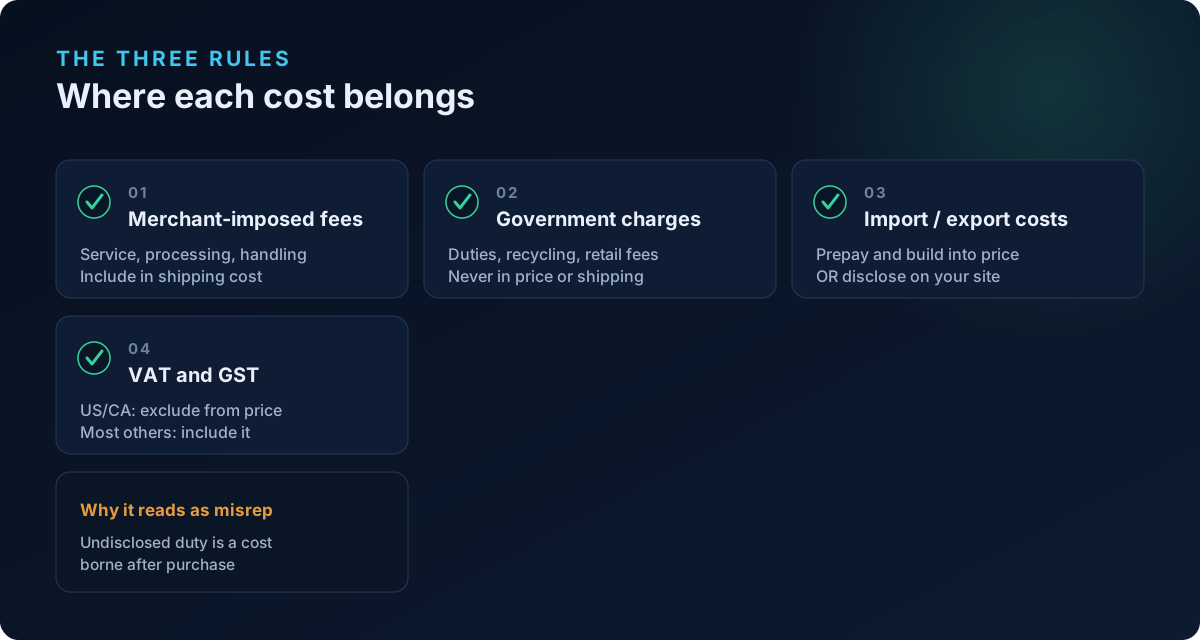
1. Merchant-imposed fees belong in shipping. Google's price guidance says to submit all additional charges you levy as a merchant — service, processing, activation, and handling fees — inside the total shipping cost. If you charge a $3 "handling fee" at checkout that appears nowhere in your feed, your total is understated.
2. Government-imposed charges belong in neither. The shipping attribute documentation is explicit: do not include government-imposed fees such as import duties, recycling fees, copyright fees, or state-specific retail delivery fees in the shipping cost. The price guidance mirrors it — government-imposed charges paid by customers should not be included in shipping charges or your price, and import- or export-related costs must not be submitted as part of the price attribute.
3. So disclose them instead. This is the half people miss. Google's instruction for import and export costs is to either include them in the price or clearly indicate those costs on your website. And for cross-border shipping specifically, it tells merchants to prominently state on the landing page that additional customs-related fees may apply, and recommends a disclaimer at checkout so users know before they place the order.
Note the asymmetry in option one: you may build duty into the product price if you genuinely prepay it (DDP), but you may not itemise it in the feed. If you don't prepay it, disclosure is not optional garnish — it is the requirement.
Why this lands as "misrepresentation" and not a price warning
Google's misrepresentation policy covers failure to clearly and conspicuously disclose the full expense a customer will bear, and all related conditions, before and after purchase. An undisclosed duty is a cost the customer bears, discovered after purchase, at the door, from a courier rather than from you.
That framing matters because it changes the failure mode. A price mismatch usually shows up as item-level disapproval you can find in the diagnostics tab. A disclosure gap shows up as an account-level review with a one-line reason and no list of offending SKUs. It also compounds with the other cross-border signals — if your store already reads as locally-based while shipping from overseas, an undisclosed customs charge is corroborating evidence rather than an isolated slip. That combination is covered in our post on concealed fulfillment.
VAT: the rule flips depending on your target country
This one causes real feed damage because merchants assume a single global answer.
For the US and Canada, do not include taxes — sales tax, GST, VAT, or import tax — in the price attribute. Tax is shown at checkout. (Google stopped requiring US sales tax configuration in Merchant Center from 1 July 2025 and removed the associated settings.)
For most other targeted countries — the UK, EU markets, Australia, India, Brazil and dozens more — the opposite applies: submit the price including VAT or GST, and make sure the landing page shows that same VAT-inclusive figure.
The trap is a Shopify store selling into both. If your tax settings display prices excluding tax to EU visitors while your feed sends the VAT-inclusive figure, or vice versa, you get a price mismatch on top of everything else. Shopify's "All prices include tax" setting and any market-specific price adjustments both feed into what the crawler sees, so check the rendered page in the target market, not the admin.
A working fix for a Shopify store
Decide your model first: DDP or DDU. Prepaid (DDP) means you pay duty and the customer never sees a bill — cleanest, and you may bake it into the price. Unpaid (DDU) means the courier collects at delivery, which is fine but obliges you to say so.
Write it into the shipping policy, in plain terms. Name the countries you ship from, state that international orders may incur customs duties, import taxes or brokerage fees, state that these are set by the destination country and are the customer's responsibility, and say they are not included in the price shown. Vague phrasing like "additional charges may apply" is weaker than naming the charge.
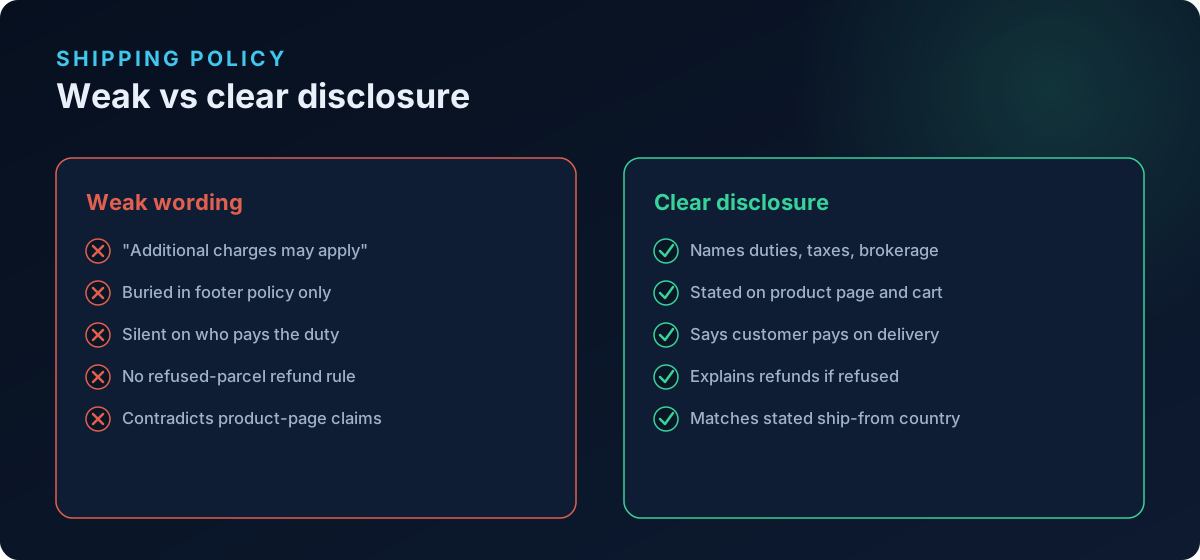
Put a line at the point of decision, not only in the footer. A sentence on the product page or in the cart carries more weight than a policy page nobody opens. Google's own wording asks for it prominently on the landing page.
Make the refund consequence explicit. State what happens if a customer refuses a parcel over unpaid duty — whether you refund the item, and whether return shipping is deducted. This is a "related condition" under the same policy.
Strip duties out of your feed. Confirm no app is injecting an estimated duty into price or shipping. If you use a landed-cost app, it should affect what's charged at checkout, not what's submitted as a government charge in the feed.
Reconcile it against everything else you've written. Your shipping policy, FAQ, product pages and returns policy must agree on who pays duty and where goods ship from. A DDP promise on the product page and a "customer pays all customs fees" line in the policy is exactly the kind of self-contradiction covered in our post on contradictory policy pages.
The check most scanners skip
Automated feed tools verify that a shipping policy page exists. Very few read it and ask whether it addresses cross-border duty at all, whether it agrees with your stated fulfillment location, or whether your VAT treatment matches your target market. That reading-comprehension layer is what our Deep scan's Trust & Identity checks were built for — the same layer that catches mail-drop addresses, brand-implied geography and NAP mismatches. You can run a free scan of your store at ShopFlixAI and see what a policy reviewer would actually find.
The short version
Duties don't belong in your feed, but they do belong on your page. If you ship across a border and the customer might pay something you didn't charge them, say so — on the product page, in the cart, and in a shipping policy that agrees with the rest of your site. Since de minimis ended, that "might" applies to far more orders than it used to.
Stop guessing why Google flagged your store
Run a free scan to see the exact issues Google checks for — then install the ShopFlix AI app to fix them automatically and stay approved.
0 Comments
No comments yet — share your experience or ask a question below.
Leave a comment