Your Merchant Center account is suspended, Google's email names no specific problem, and every app listing you open promises to "fix" it. You are right to be skeptical.
Full disclosure before anything else: we build one of these apps. ShopFlix AI is our product. That makes us biased — and it also means we know exactly where the limits of this category are, because we hit them every day. This post is the answer we'd want if we were on the other side of the screen: what compliance apps genuinely do, what no app on earth can do, and the situations where you shouldn't pay anyone at all.
The short answer
Yes, the good ones work — for a specific class of problem. That class is: store-side and feed-side policy violations that Google detected but won't name for you.
Merchant Center suspensions, especially Misrepresentation suspensions, are notorious for one thing: Google tells you that you violated policy, almost never which page, which product, or which sentence. The entire value of a compliance app is closing that gap — systematically checking your store against the policies Google actually enforces, so you fix the real cause instead of guessing.
What no app does is change anything on Google's side. Keep that split in your head and every marketing claim in this category becomes easy to evaluate.
What a good app CAN actually do
1. Find the policy gaps Google won't name
This is the core job. Google's suspension emails cite a policy ("Misrepresentation," "Untrustworthy promotions") and stop there. A proper scanner checks the concrete, documented triggers behind those policies:
None of this requires magic. It requires checking a few hundred things a stressed merchant won't think to check, on every page, consistently. Software is genuinely better at that than a human at 2 a.m. Our 2026 compliance checklist lists the checks — an app just runs them for you at scale.
2. Fix store-side causes, not just report them
The better apps go beyond a PDF of problems. Generating compliant policy pages, adding required disclosures, fixing structured data so your prices and availability match your feed — these are mechanical fixes an app can apply or draft for you. The difference between a scanner and a fixer is whether you're left holding a to-do list.
3. Repair feed and product-data issues
This is the most mature part of the category. Product disapprovals for missing GTINs, mismatched prices, wrong availability, image violations, or bad condition/identifier_exists attributes are exactly what feed apps were built for. If your problem lives in the feed, an app is unambiguously the right tool — this is solved software.
4. Flag trust and identity contradictions
The newest and least-understood layer. Google's systems increasingly cross-check who you claim to be: business name vs. domain registrant vs. footer address vs. payment descriptor vs. Google Business Profile. A mismatch reads as deceptive even when it's just sloppy. This is the layer that catches merchants who get suspended again after "fixing everything" — and it's almost impossible to see from inside your own business, because you know who you are. A scanner doesn't, which is exactly why it catches the contradiction.
5. Draft a coherent appeal
An appeal that says "we fixed it, please recheck" fails. An appeal that names each violation found, the fix applied, and the URL where Google can verify it has a real chance. An app that just did the scan has all of that material and can draft the appeal properly. (The submission itself is still you — see below.)
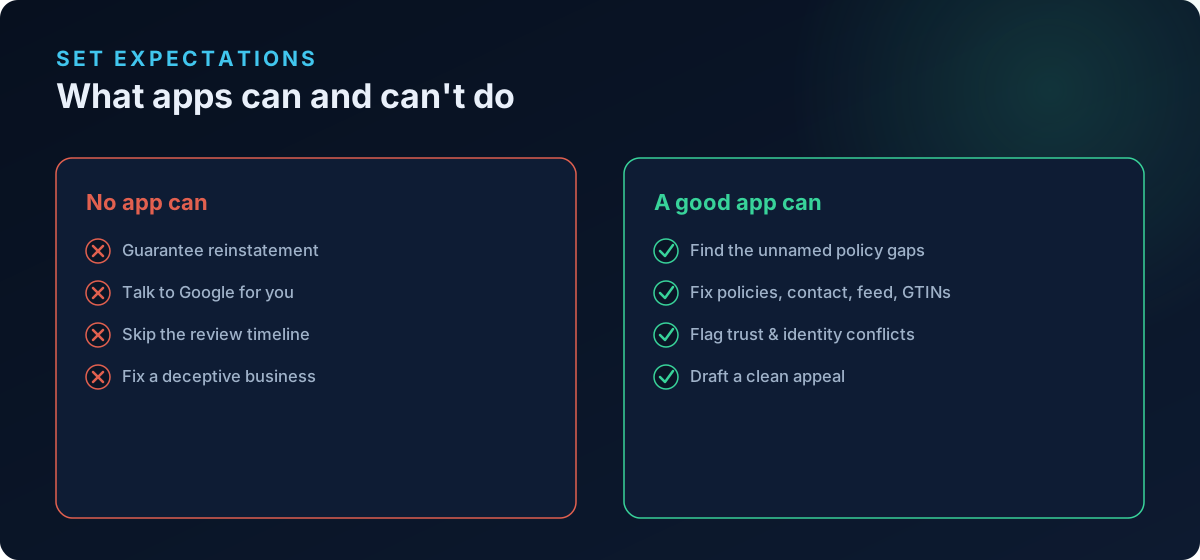
What NO app can do — and the claims that should make you close the tab
Be suspicious of any product that implies otherwise on these four points:
No app can talk to Google for you. There is no API for appeals, no back channel, no partner hotline that overturns suspensions. The appeal goes through your own Merchant Center account, and Google's reviewers evaluate your live store. Anyone implying insider access is lying to you.
No app can guarantee reinstatement. The reviewer's decision is Google's alone. An app can maximize your odds by making sure the store a reviewer sees is genuinely compliant — that's it. "Guaranteed reinstatement" in a listing is itself a misrepresentation, which is a special kind of irony in this category.
No app can fix a genuinely deceptive business. If products never ship, if reviews are fabricated, if the "70% off" price was never real — no software makes that compliant, and we'd rather say so than take the subscription. Google's detection is imperfect but it is not stupid.
No app can bypass review timelines. After an appeal, review takes days to weeks. Cooldown periods after failed appeals are real. Software cannot accelerate a queue inside Google. What it can do is make sure you don't burn an appeal attempt on an incomplete fix — because failed appeals are expensive, as the reinstatement guide explains in detail.
When you do NOT need an app
Honesty cuts both ways, so here is the anti-pitch:
- A single disapproval with a named reason. "Missing GTIN" on three products, an image with promotional overlay text, a price mismatch on one item — Google told you the problem. Fix it in ten minutes, request a re-review, done. Paying for software here is paying someone to read an error message to you.
- Preemptive fear with no symptoms. If your account is healthy, a one-time pass through a good checklist beats a subscription. (A free scan is a fine sanity check precisely because it's free.)
- A suspension you already understand. If you know your checkout was broken and you've fixed it, you may only need help wording the appeal — not a tool.
When an app pays for itself
The tools that actually exist (verified, August 2026)
We checked every one of these ourselves before naming it — this category attracts vaporware and AI-hallucinated "apps" that don't exist. What follows is only what we verified, with only the claims we saw:
- Simprosys Google Shopping Feed — the veteran feed app (since 2017), 4.9 stars across thousands of reviews, from $4.99/mo with a 21-day trial. Feed management for Google, Meta, Microsoft and Pinterest. A feed tool, not a store-policy scanner.
- Nabu for Google Shopping Feed (AdNabu) — Built for Shopify badge, 4.8 stars, free plan with paid tiers from $29.99/mo. AI-assisted feed optimization and error fixing. Again: feed-focused.
- CedCommerce Google Feed — 4.5 stars, free for up to 20 products, strong multi-country support and product profiling for targeting.
- DataFeedWatch — the heavyweight multi-channel feed platform, 4.8 stars, from $64/mo. Overkill for a single suspension; built for agencies and large multi-channel catalogs.
- FeedArmy — not an app but a human consultancy that specializes in suspension diagnosis, with management fees in roughly the $180–$720/mo range. The honest comparison point: a good human expert can do everything an app does plus judgment calls, at 10–40x the price.
- ShopFlix AI — ours, so discount accordingly. Where the apps above focus on the feed, we focus on the suspension problem: a store-wide policy scan (including the trust/identity layer), applied fixes, deterministic re-checks against your live store, and appeal drafting. Free scan, free plan, paid tiers from $4.99/mo. Details on /features.
Notice the pattern: the established apps are overwhelmingly feed tools. They're excellent at product-data problems and mostly silent on store-level Misrepresentation triggers — policy pages, contact info, identity consistency — which is where most unexplained suspensions actually live. Match the tool to your problem. Our buyer's guide to choosing a compliance app walks through that matching in detail, and our 2026 app comparison covers the field one by one.
How to test any of these without risking a dollar
The zero-risk test is simple: run a free scan before you pay anyone — including us. Put your store through our free Merchant Center scan and look at what comes back. One of three things happens:
- It finds concrete, specific violations you can verify with your own eyes. Now you know the tool sees real things, and you can decide whether to fix them yourself or pay for help.
- It finds nothing, and your suspension cause lies elsewhere — you just saved a subscription.
- It finds vague, unverifiable "issues." Close the tab and try another tool. That test applies to every product in this category, ours included.
An app that won't show you real findings before charging you is telling you something.
Can any app guarantee my Merchant Center account gets reinstated?
No. The reinstatement decision belongs to Google's reviewers alone. An app can only make sure the store they review is genuinely compliant — any listing that promises guaranteed reinstatement is itself misrepresenting.
Do I need a fix app for a single product disapproval?
Usually not. If Google named the reason — a missing GTIN, a price mismatch, an image violation — you can fix it yourself in minutes and request a re-review for free.
How do I test a Merchant Center fix app before paying?
Run its free scan and check whether the findings are concrete and verifiable on your own store. If the results are vague or the app won't show findings before charging, move on to another tool.
Bottom line
Do Merchant Center fix apps work? For diagnosis and store-side repair: yes, demonstrably. For anything involving Google's side of the wall — appeals decisions, timelines, guarantees: no, and nobody honest claims otherwise.
Skip the app for a single named disapproval. Strongly consider one if you're suspended without explanation, run a large catalog, or keep getting re-suspended. Test with a free scan before paying anyone. And whatever you use, submit the appeal only when the store a Google reviewer will see is actually clean — because that reviewer is the one audience no app can reach.
Stop guessing why Google flagged your store
Run a free scan to see the exact issues Google checks for — then install the ShopFlix AI app to fix them automatically and stay approved.
0 Comments
No comments yet — share your experience or ask a question below.
Leave a comment