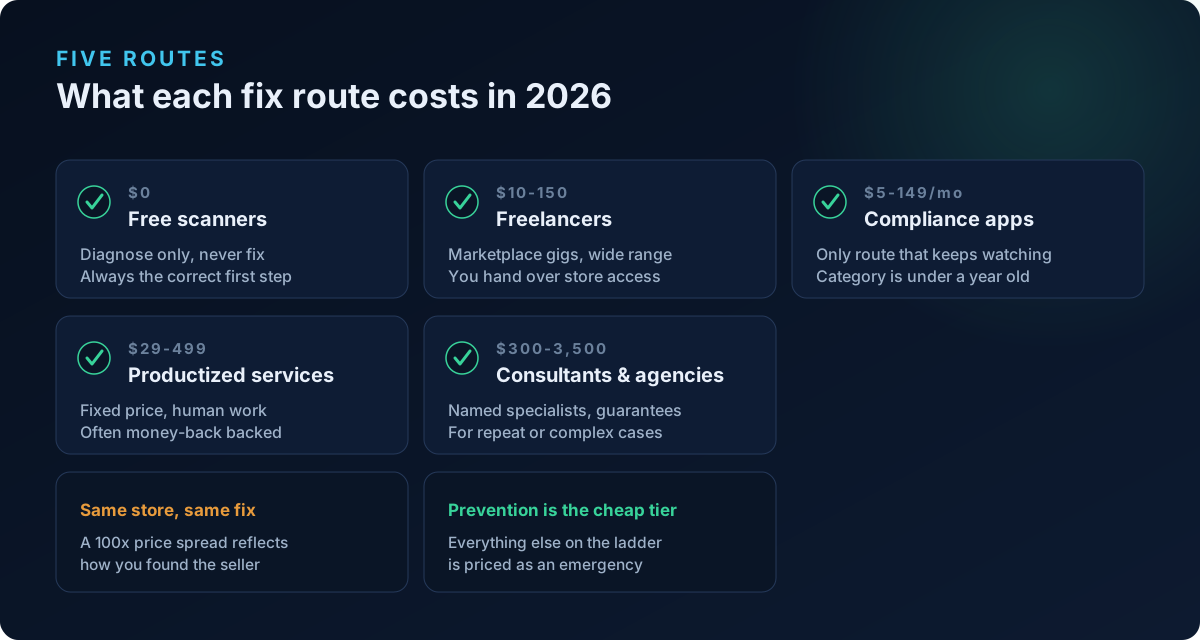
Here is the strangest thing about the Merchant Center suspension market: the exact same problem — one store, one Misrepresentation notice, one set of policy violations — can be quoted at $0, $29, $99, $399, or $3,500. Same store. Same fix. A hundredfold spread.
That spread is not a difficulty scale. It's a market structure. A suspension is one of the few e-commerce emergencies where the buyer is panicking, the cause is invisible, and nobody advertises a price list — so the price ends up reflecting how the seller found you, not how hard the work actually is.
We priced the entire landscape in early August 2026: every compliance app on the Shopify App Store, the feed apps merchants get pointed to by mistake, the free web scanners, the freelancer marketplaces, and the agencies that handle it end-to-end. Every figure below was read from the provider's own live listing or website.
One disclosure before you read a word of it: ShopFlix AI is our app. It appears in the comparison because leaving it out would be coy, not because this article exists to sell it. Judge that section more harshly than the rest — and re-check every price here, because they change.
Why the spread is so wide
Almost every suspension is the same category of problem. StubGroup, a Google Premier Partner agency that specialises in these cases, reports that roughly nine in ten of the suspensions they handle are classified as Misrepresentation — the policy Google enforces on whether your business looks real, reachable and honest, rather than on the formatting of your product data.
Misrepresentation is also the category with the least useful notice. Google tells you the policy name and nothing else. No line item, no offending URL, no "fix this field." The merchant is left doing archaeology on their own store — and that information gap is what the entire market is priced against. You are not really buying a fix. You are buying somebody's opinion about what Google objected to.
Once you see it that way, the ladder makes sense: free tools sell you a guess from a public crawl, freelancers sell you a cheap human guess, agencies sell you an expensive experienced guess, and software sells you a systematic one that keeps running.
Route 1 — Free scanners ($0)
Free scanners crawl your public storefront and report what looks non-compliant. They are genuinely useful as a first move, and you should never pay anyone before running at least one.
| Tool | What it checks | The catch |
|---|---|---|
| AdNabu Misrepresentation Checker | 22 weighted checks: policies, payment methods, SSL, contact info, domain age, placeholder content | Free lead magnet for AdNabu's paid feed app |
| ShieldKit | 8-point scan: contact info, payment icons, JSON-LD | Shallow by design; the full report wants an email |
| Why Disapproved (Shopify app) | 29 catalog checks with plain-English reasons and deep links into your admin | Read-only and catalog-only — never touches store-level trust signals |
| GMC Store Readiness Scanner (free tier) | 2 scans a month, 10 products | Unlimited scanning is a one-off $9.99 |
| ShopFlix AI free scanOurs | Store-level policy, identity and contact-consistency audit | Deeper tiers and the auto-fixes are paid |
The honest limitation of every free scanner, ours included: a public crawl sees what a visitor sees. It cannot see your Merchant Center account history, your suspension notice, or the specific product a Google reviewer clicked. Treat free output as a strong hypothesis, not a verdict.
Route 2 — Shopify compliance apps ($5–$149/mo)
This is the newest corner of the market and it is tiny. Every dedicated compliance app we could find on the Shopify App Store launched between December 2025 and July 2026, and between them they had barely a dozen reviews when we checked. That isn't a knock on the products — it means you're an early adopter in a category Google's own enforcement created less than a year ago.
| App | Price | Reviews (Aug 2026) | What stands out |
|---|---|---|---|
| ClearCheck Compliance | Free / $27.99 / $49.99 per mo | 5.0★ (5) | Named "Trust & Identity Checks"; Pro adds human-reviewed audits |
| ComplianceGuard AI | Free / $49 per mo / $149 per mo rescue pass | 3.6★ (3) | Daily monitoring; one-click AI policy-page writer |
| Complify | $20/mo | No reviews yet | Listing and policy scan with a live compliance score |
| Get Compliant | $15/mo or $150/yr | 4.4★ (2) | Scans product titles and descriptions before submission |
| GMC Store Readiness Scanner | $9.99 one-time | 5.0★ (2) | 38 checks and a PDF report — cheapest serious option |
| ShopFlix AIOurs | Free scan; $4.99–$99/mo | — | Auto-fixes what it finds and drafts the appeal letter |
Why this route is structurally different: every other option on this page is an event. You pay, someone fixes it, the transaction ends. An app is a subscription to not being suspended again — it re-scans after Google's policy updates, after you install a new theme, after a bulk import quietly breaks your structured data. If you've been suspended twice, that difference is the whole ballgame.
Two things worth checking before subscribing to any of them, ours included:
- Does it check store-level trust, or only your catalog? Product-text scanners are fine tools that will not resolve a Misrepresentation suspension. Our breakdown of how to choose a compliance app lists the specific questions to ask.
- Does it change anything, or only tell you? Most of this category scans and hands you instructions. Whether that's enough depends on how much time and Liquid confidence you have.
Route 3 — Feed apps (the expensive detour)
Search "app to fix merchant center suspension" and you'll be handed feed apps — the biggest, best-reviewed, most-installed apps in the category. They are excellent products. They are also, for a suspension, usually the wrong purchase.
| App | Price | Reviews | Suspension features |
|---|---|---|---|
| Simprosys Google Shopping Feed | $4.99–$17.99/mo | 4.9★ (4,346) | None listed |
| Google & YouTube (official) | Free | 4.5★ (5,052) | None |
| CedCommerce Google Feed | Free–$49/mo | 4.5★ (514) | Shows item-level disapprovals |
| Nabu / AdNabu | Free-to-install–$249.99/mo | 4.7★ (510) | Feed-error suggestions |
| DataFeedWatch | $64–$599/mo | 4.7★ (285) | None |
| Google Merchant Center Sync (Anowave) | $17–$70/mo | New listing | Adds a misrepresentation scan on higher tiers |
The distinction that saves you money: feed apps fix products; suspensions are about accounts. A feed app will clean up mismatched prices, missing GTINs and broken availability — real causes of item-level disapprovals, which we cover in why products get disapproved. But a spotless feed inside a suspended account changes nothing, because Google isn't objecting to your data. It's objecting to your store.
Watch for the price-ladder trap too: Simprosys runs $4.99 to $17.99 a month, almost exactly what compliance apps charge. Similar price, completely different job.
Route 4 — Freelancers and marketplaces ($10–$300)
Fiverr has a dense supply of "fix your Merchant Center suspension" gigs. When we looked, the ladder ran from $10 to $150 for the general pool — with most sellers clustered in the $20–$100 band — and Fiverr's own cost guide puts GMC specialists at $7–$100 an hour, or $40–$250 per project.
At the top of that market sits a genuine specialist: Emmanuel Flossie (FeedArmy / MerchantCodex), the best-known independent GMC authority, with 260+ five-star Trustpilot reviews. His Fiverr consultation is $300; his own site lists a $399 one-time suspension consultation; his membership community runs roughly $69–$129 a month, with private audits at $999.
What you're really trading: a $25 gig and a $399 consultation are not the same product with different markups. The cheap end is somebody running a checklist against your store — fine if your problem is a missing refund policy, useless if it's an identity mismatch. The expensive end is somebody who has seen your exact failure pattern a hundred times.
And the access question matters more than the price. Every freelancer route requires handing Merchant Center access — usually Shopify admin access too — to a stranger. Add a user with the narrowest role that gets the job done, and remove it the day the work ends.
Route 5 — Productized services and agencies ($29–$3,500)
At the top of the market, price stops correlating with the work and starts correlating with the guarantee.
| Provider | Price | Guarantee |
|---|---|---|
| gmccheck.com | $29 one-time fix plan | None — you get the plan, you do the work |
| gmcsuspension.com | $99 one-time, after a free 52-check audit | 7-day money-back if still suspended |
| OptiMerchant | $299–$499 by suspension type; $129/mo monitoring | None stated |
| GMBJet | $497 — $97 deposit, balance on reinstatement | Claims a 99%+ success rate |
| KeyCommerce | Not published | 30-day money-back; claims 300+ accounts reinstated since 2015 |
| StubGroup | Not published; free initial audit | None — they'll tell you if there's no path |
| Webrageous | $3,500 flat | Money back if not reinstated within 49 days |
Two patterns are worth internalising.
A money-back guarantee is the actual product at the top end. Webrageous charges $3,500 and refunds it if you're not reinstated within 49 days. You are buying insurance and somebody else's risk — not thirty-five times more labour than the $99 service.
Success-fee structures are a real signal. GMBJet takes $97 up front and the remaining $400 only on reinstatement. Any provider willing to be paid on outcome has told you something useful about their own confidence.
One caution: one provider here advertises a success rate ("99%+", "guaranteed approval") that no outsider can verify — Google alone decides reinstatements, and no vendor controls that. Reputable operators say so plainly on their own pages. Treat a guarantee you can enforce (a written refund policy) as real, and a percentage you can't audit as marketing.
The gap nobody in this market fills
After pricing all five routes, one thing stood out. Across every Shopify compliance app we checked, not one lists suspension recovery or appeal-letter generation as a feature, and only one offers even a partial automated fix (AI-written policy pages). Everything else in the software tier scans and instructs; everything that actually does the work is a human being charging $99 to $3,500.
That gap is exactly why we built ShopFlix AI the way we did — the scan doesn't stop at a list, it repairs what it finds in your store and drafts the appeal from the evidence of those repairs. You should still weigh that claim against the honest question of whether these apps work at all, which we wrote precisely because the answer isn't automatically yes.
Choosing without overpaying
Match the spend to the situation, not to the panic:
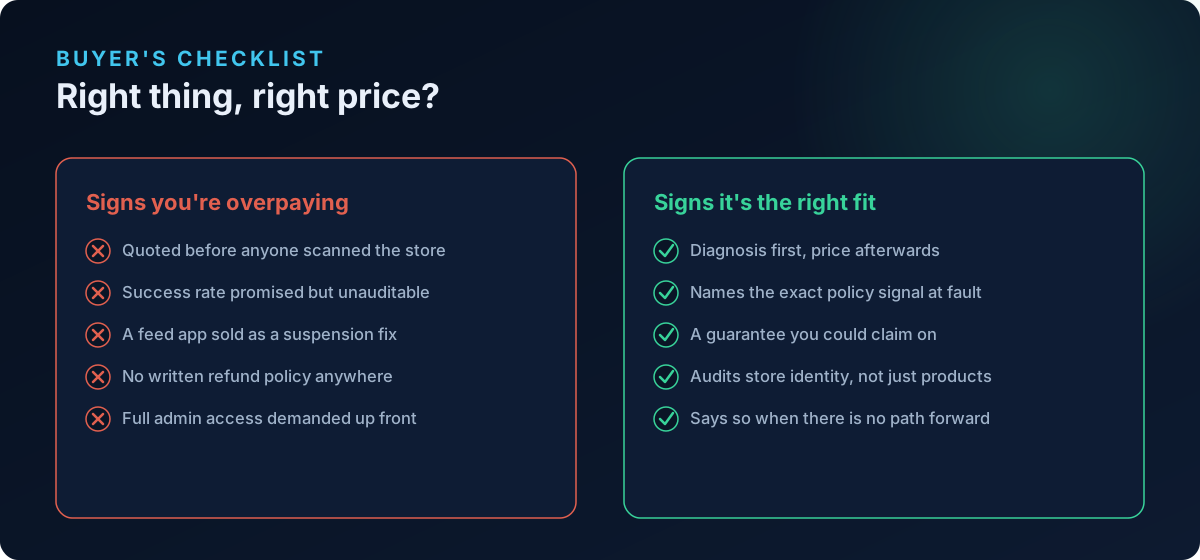
- First suspension, cause unknown — free scan first, always. If it names something obvious (no refund policy, an unreachable contact page, a placeholder address), you can very likely fix it yourself for nothing. Our reinstatement guide walks the whole sequence.
- Cause clear, no time — a $99–$499 productized service is fair value, especially one with a refund promise.
- Fixed everything and got suspended again — stop buying fixes and audit the trust-and-identity layer: business name, address, phone and contact details agreeing across every page. That failure pattern has its own article, and NAP consistency is usually the culprit.
- High revenue at stake, or appeals already rejected — go to a named specialist. When Shopping is your main channel, a $3,500 fee with a refund clause can be cheap.
- Not suspended yet — the best position on the entire ladder, and the cheapest. Everything above is priced as an emergency; prevention is priced as software.
How much does it cost to fix a Google Merchant Center suspension?
Anywhere from $0 to $3,500 in 2026. Free scanners diagnose; Shopify compliance apps run $5–$149 a month (plus one $9.99 one-time option); freelancers charge $10–$300; productized services $29–$499. Specialist agencies mostly quote privately, with $3,500 the highest published fee we found, and the premium ones often carry a money-back clause. Most first-time Misrepresentation suspensions have a cause the merchant can fix themselves once they know what it is.
Can I fix a Merchant Center suspension myself for free?
Often, yes. The blocker is almost never the difficulty of the fix — it's that Google's notice doesn't say what's wrong. Run a free scan, correct what it finds, then appeal with a clear description of the changes you made.
Will a Google Shopping feed app lift my suspension?
Usually not. Feed apps fix product data, which resolves item-level disapprovals. Account-level suspensions such as Misrepresentation come from store-level trust and policy signals a feed app never examines.
Are "guaranteed reinstatement" services legitimate?
Google alone decides reinstatements, so no third party can truly guarantee one. Judge the enforceable part instead: a written money-back policy you could actually claim on. Treat unverifiable success percentages as marketing.
Is it safe to give a freelancer access to my Merchant Center?
It's a real risk to weigh. Grant the narrowest role that lets them work, never share your Google password, and remove the access the day the engagement ends.
How long does reinstatement take?
Vendors quote 3–10 days for their own work; Google's own review time varies and isn't published. The bigger variable is how many attempts you've already spent — repeated weak appeals make later ones harder, which is why fixing thoroughly before appealing matters more than appealing fast.
The one-line version
The market charges between nothing and $3,500 for the same underlying job, and the price mostly reflects how you found the seller. Start free, find out what's actually wrong, and only then decide whether this is a problem worth $99, worth $499, or worth a subscription that stops it happening again.
If you want the diagnosis part for free, run a scan on your store — it takes about a minute and tells you exactly which policy signals your storefront is failing.
Prices, review counts and features were read from each provider's live listing or website in August 2026 and change often. FeedArmy's and Fiverr's pages block automated access, so those two prices were confirmed via search-index listings rather than read directly. ShopFlix AI is our own product; every other company named here is independent, with no relationship to us.
Stop guessing why Google flagged your store
Run a free scan to see the exact issues Google checks for — then install the ShopFlix AI app to fix them automatically and stay approved.
0 Comments
No comments yet — share your experience or ask a question below.
Leave a comment